Dynafit ONE PX TF 30.0

dynafitONEOverview

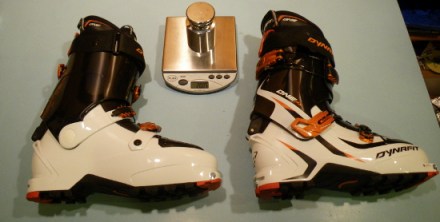
Christmas in November! When ZZero PX boots failed under warranty, Dynafit/Salewa sent a pair of the new Dynafit ONE PX as a replacement. Stoked.

Finish and mechanical quality is excellent. Boots are comfy and solid around the house. Palpably stiffer than the ZZero PX, but the walk mode is superior to the TLT4. I anticipate that these boots will ski well.

Continue reading

UW Crime Notifications

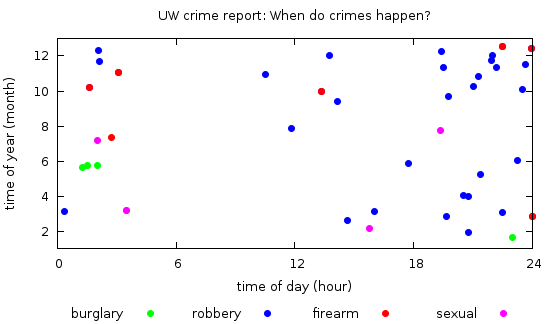
This afternoon, the University of Washington Police emailed another “Notification of a Criminal Incident” (a student was robbed for $20 and a six-pack of Dr. Pepper).  I forwarded it to a friend north of the University, and she replied, “Remind me never to walk south from my house after 11 p.m.”

That got me wondering. When do these notable crimes happen, and where? In email archives, I found 47 emails from the last 2.3 years.

When do crimes happen near campus?

Where do they happen?

I added ~1/2 block randomness to spatially separate multiple crimes at the same location.

Off-Piste 2012

What can we see if we look at this year’s skis alone (see previous ski post for year-to-year retrospective)? All of these points are drawn from Off-Piste’s 2012-13 backcountry ski review. OP chose not to review any skis narrower than 90 mm this year.

What ski sizes are available?

In the plot above, if a manufacturer only offers a ski in one length, it’s ‘size 1’. If they offer skis in multiple sizes, each size gets its own point. 112mm waists get a little extra love; DPS look-alike contest?

Continue reading

Metolius FS Mini, Black Diamond Neutrino

Back to business, measuring mass.

Carabiner weight matters to climbers. Sure, if one biner is 10 grams heavier than another, it’s no big deal. But, if you multiply by 20, that’s almost a half pound. The BD Neutrino, and later, the Metolius Mini carabiners have both advanced the cutting edge of lightweight climbing hardware. I like ’em both enough to have a few. Everything measured here was purchased in or before 2010.

These biners are lightly used, so they will be slightly lighter, and have more variation, than new.

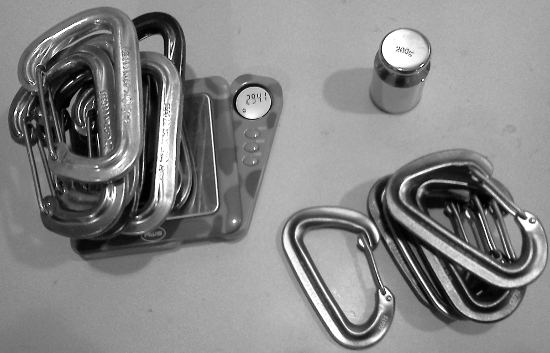
Neutrinos:

Neutrinos individually:
36.9 36.9 36.7 36.9 36.9 36.4 36.7 36.3

Weighed together: 294.1 g.

Correcting for finite sample size, these numbers give 36.8±0.3 g. 

The lighter two biners are not anodized, and were purchased in 2009. The other 6 were from a “rack-pack” purchased in late 2010 and are anodized. It’s possible that anodization or a manufacturing change added a tiny amount of mass.

Black Diamond claims 36g. With these few measurements, 37g would be more appropriate, but there’s not enough resolving power here to tell the difference between 36±1 and 37±1.

It’s a go-to carabiner. Thanks for making it, BD.

Metolius mini FS

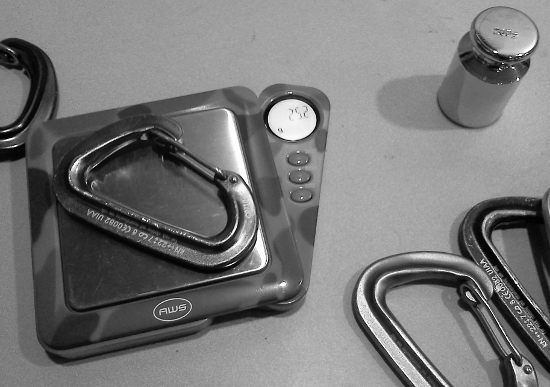
Weighed individually:
25.3 25.2 25.2 24.5 24.9 25.2

Weighed together: 150.4 g

Correcting for finite sample size, these numbers give 25.1±0.3 g.

Purchased in autumn 2010.

Metolius claims 25 g. Right on.
Ski Evolution

At the Northwest Snow and Avalanche Workshop this weekend, Off-Piste Magazine handed out free copies of the October issue as usual. Thumbing through the ski review, I couldn’t help but wonder: How have things changed over time?

Thanks to Off-Piste’s deep archive of back issues, only tedious retyping was needed to find some answers.

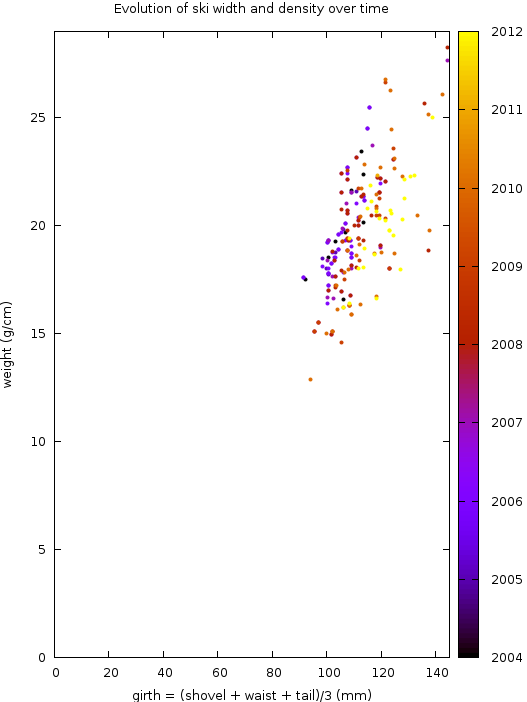
This is the money plot:

The absolute scale makes the scatter part of the plot small, but you can see by exactly how much skis have widened and lightened over time.

For zoomed in plots and more, head down the rabbit hole. Continue reading

Free Bagels

Free food is a standard perk/fact in the modern software industry. It saves people time, lets them focus on work, and makes them feel appreciated.

It works for Google, but can it work for our academic lab of ~50 people? Will ravenous students eat infinitely many bagels? How much does it cost to provide free food to employees?

Experiment is the arbiter of truth.

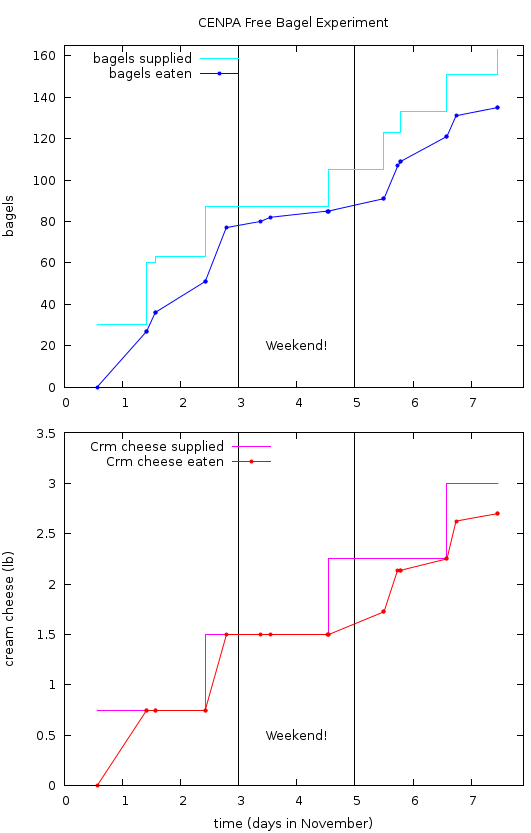
An email made it known that 30+ bagels a day would appear in the breakroom for at least a week, and I kept a tally of bagel consumption over time. Sufficient attention to supply ensured that we never ran out.  Happy bagel eaters were skeptical at first (“Are these really free?”, “What’s with all the bagels?”, etc.), and then hopped aboard the plan.

The answer? ~27 bagels/day, or less than $15/day. Cream cheese is ~30x more popular than butter.

It’s a rather inexpensive experiment (bagels averaged <$0.50 cents each), and it’s provided the faculty with the information they need decide whether or not they could fund such a program.

Best of all, it was fun!

Storm Surge

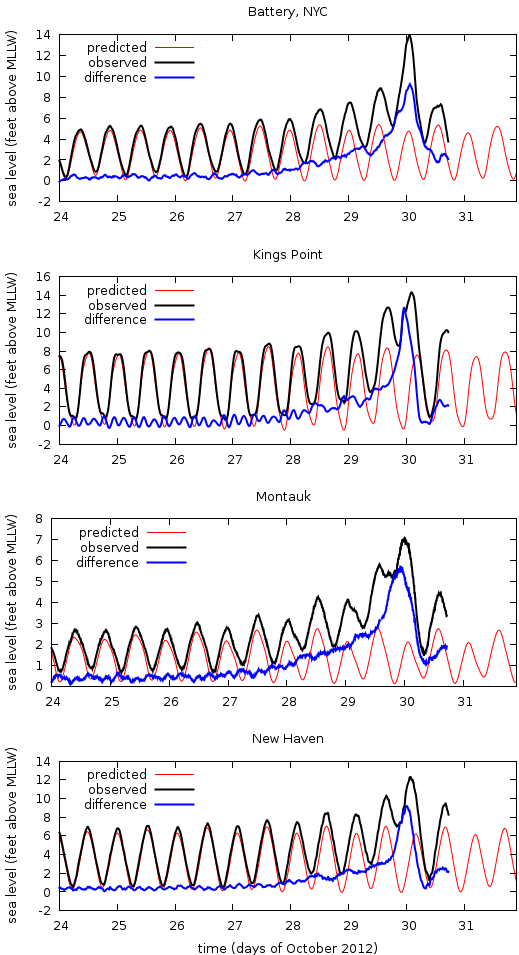
Thanks to the excellent data/interface provided by NOAA (click here for Montauk data), I was able to throw these plots together.

I have family on Long Island. As I understand it, if Hurricane Sandy’s storm surge is more than ~6 feet above high tide, the house will flood. So, I’m interested in the current ocean level. It’s still early in the storm, but the plots don’t look good.

For realtime updates, click the NOAA link above.

Plots updated 10:45 AM PDT 10/30/2012, final update. Status of the house is unknown, but everyone’s fine. Note small after-surge that’s happened today. Neat.

Measured sea level at  The Battery, Montauk, Kings Point, and New Haven during Hurricane Sandy. Data are NOAA measurements. ‘MLLW’ is “Mean Lower Low Water”

Good luck to everyone on the East Coast!

More HN numbers

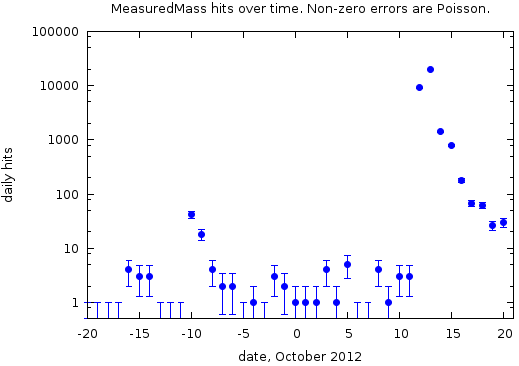
I’m curious whether the Hacker News post will lead to long-term increased traffic.

Edit: 10/30/2012. After the post regarding Hurricane Sandy, this experiment had to end; traffic from the new post started to matter. These numbers are the total hits to all-things measuredmass, not just the Google post. So, the above is the final plot. 

By October ~26 (that spike) traffic was coming in bursts from various countries, especially Germany. I’m not sure that the >10 hits/day rate would have remained sustainable for more than another few weeks. Time will tell. 

Hacker News

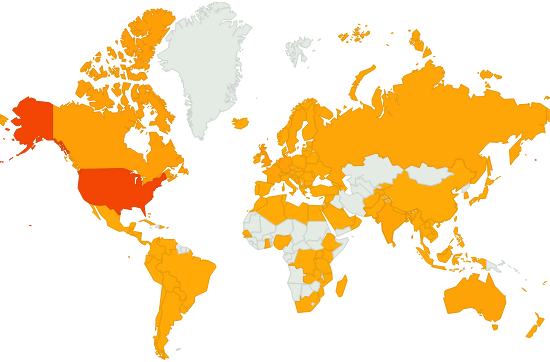
140 countries in a day! 30,000 hits!

Whoa.

I didn’t expect that post to reach the top spot on HN, let alone stay there. It would’ve been neat just to ping around on the front page for a bit before falling to obscurity. I’m glad you’re curious about it too.

Now I’m curious about you : ).

Continue reading

Google Homepage Size Over Time

This afternoon, I looked at the source of the main Google page with my browser. It spans my whole monitor and takes 15 pushes of the scroll-wheel to see it all. Whither minimalism?

Off to the Wayback Machine. One must be careful to avoid including Wayback Machine Javascript and comments when assessing file size. I think I got it right. File sizes were assessed with `ls -l`, and included only the size of the ‘.html’ file, no images or fanciness. Dates were sampled pseudo-regularly, trying to get about two points/year.

6 points corrected. Thanks ‘qxcv’! Archive, curl, and browser data noted. Thanks ‘zzzwat’!

Time for a log plot. The difference between a browser-acquired page and a simple curl request is an order of magnitude.