Dynafit Broad Peak Carbon Ski Pole 2013

broadPeakPoleOverview

I’ve been toying with the idea of carbon poles for a while. With a gift card generously donated by Evo to the NSAS raffle burning a hole in my desk drawer, I finally gave in.

My original preference would’ve been the BD poles, on reputation alone, but they weren’t in stock for the season.  A friend uses the Dynafit poles with gusto, adding a plus to the Dynafit column. This thread, however,  makes me more than a little concerned for durability.

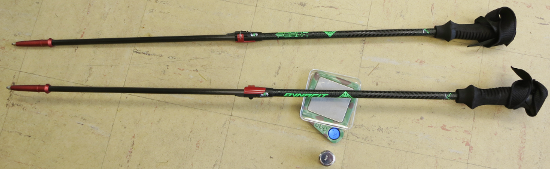
On to the real thing. With the usual concerns about extracting uncertainties from two measurements, the poles themselves weigh 180.9±2.4 g. The baskets are 13.5±0.4 g. In combination, they’re 194.4±2.4 grams. Dynafit’s claimed weight is 190 grams.
broadPeakPoleLatchView

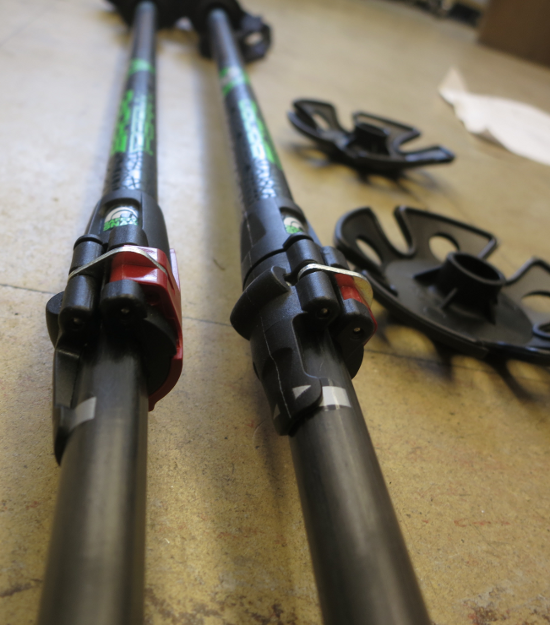
The Dynafit pole lowers aren’t round, they’re D-shaped, with notches cut in them to physically block the pole from slipping. The engineering and build quality feels very fine; time will tell if the complicated linkage will hold up to years of use. I’m rather partial to the BD flicklock system (why did BD move to something with more moving parts?!), but this system seems reasonable. Dynafit has a two-year warranty on the poles.

Review/more photos below the bump.
Continue reading

Ski Density

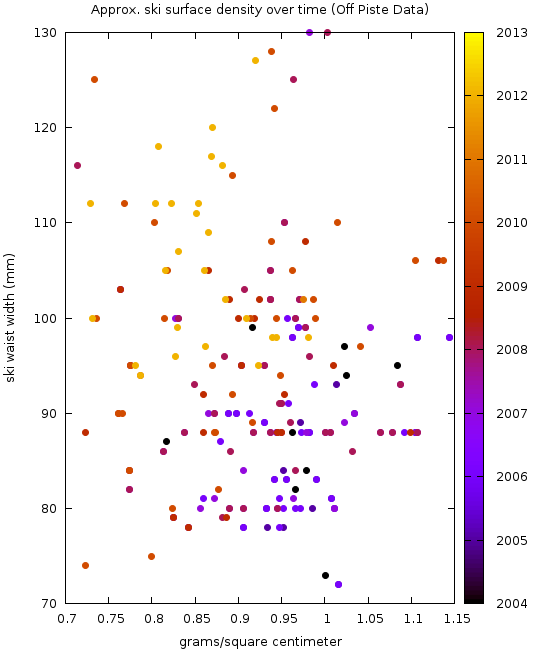
A thread over on Wildsnow got me digging back into the Off Piste data set. While in the past, I’d looked at weight per unit length vs girth, it’s also possible to plot against surface area (or surface density).

opSkiArea

The ski surface area is computed with a formula which is both atrocious and practical. If M is a ski’s mass, S is the width of the ski shovel, W is the waist, T is the tail, and L is the length of a ski, then the density D plotted on the horizontal axis is

D= \frac{M}{( S + 2 W + T) \times L / 4}

Be certain that you’ve used the right units (grams and centimeters, even for the width dimensions).

This treats the ski as two trapezoids, joined at the waist. This will tend to over-estimate the area of a ski, and hence underestimate its density. Relative comparisons of skis should be more accurate than the absolute density determined by this method. With densities determined this way, it would appear that anything in the 0.7-0.8 g/cm^2 realm is light by modern standards.

The Dynafit Cho Oyu’s claimed weight/dimensions would put it at 0.60 in these units (note that the pintail will pull the “trapezoidal density” down. Prototype skis from Ski Lab would land in the 0.64 realm.