Fischer CRS Skate Vasa 192 cm


fischerCRSSkateFull


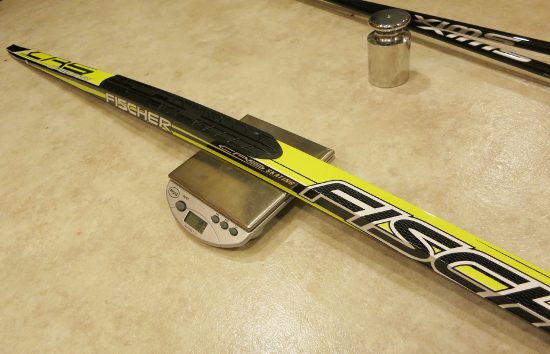
The skate gear continues. As a review goes, I’m still calibrating myself as much as the skis for skate gear. No flaws, binding mount went smoothly, skis go fast.

If you’re looking at the photos, the 2000/2006 g calibration factor applies to this scale. One ski weighed in at 700 g, the other at 708 g. With the usual caveats (2 measurements is a poor way to sample a distribution),  this comes to 704±7 grams for each ski. I can’t find a spec from Fischer for the 192 cm ski.

Continue reading

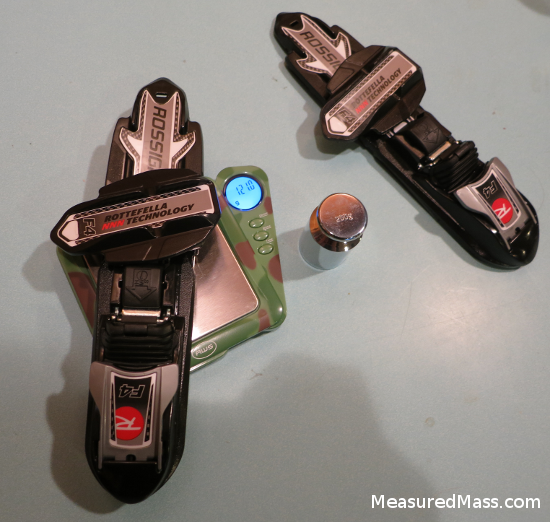
Rossignol F4 Skate NIS Binding

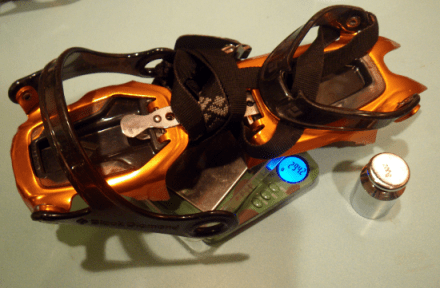
Skate gear is starting to cross the MeasuredMass scales. Once these bindings get some snow time, I’ll post a review. What did they say on the scale?

rossignolF4Skate

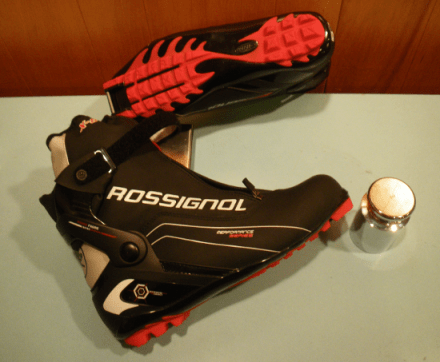
121.0 g and 121.3 g, respectively.  Two samples is too small to reliably estimate an uncertainty, but if I do, it’s 121.15±0.27 g.  Rossignol quotes 240 g/pr, so these might be less than 1% high, but without an uncertainty from Rossignol (depending on significant digits, that 240 could be 240±5), it’s impossible to tell.

Looking forward to getting some time on them!

Vasa

The skate skiing hook may have been set – it turns out that skate skis are fun going downhill too. A perusal of available nordic skis reveals a preponderance of skis from many manufacturers all labelled ‘Vasa’.

What, where, or who, is Vasa? The man who led Sweden to independence was Gustav Vasa. A 90 km ski race that follows a historically important route is called the Vasaloppet (think the original Marathon). The race is huge, and the mass start is incredible.

Whence Vasa on every ski? I’m not certain. This post suggests that mass-start skis are labelled Vasa. If you’ve more information, please leave a comment! (thanks!)

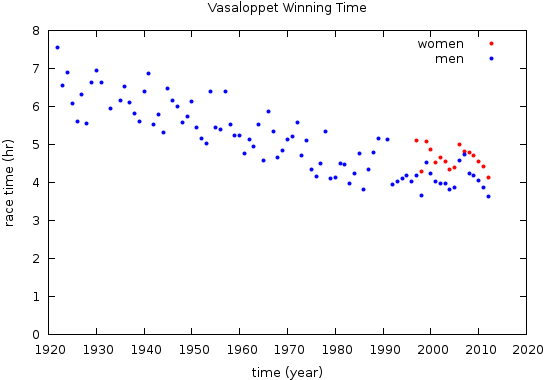
It wouldn’t be a measuredmass post without a plot; here are the winning times since 1922, as found on Wikipedia.

vasaloppetWinningTime

ACR ResQLink

I’d been thinking about a serious rescue beacon (PLB) for a long time, perhaps leaning toward the DeLorme InReach, when the ResQLink arrived under our tree. The two-way communication feature was very attractive, but the requirement of a (hardly rugged and heavy) smartphone and the substantial subscription fee kept me from buying in.

We decided not to let the perfect in the way of the good, and I’ve kept the ResQLink. The NOAA registration online was quick and easy.

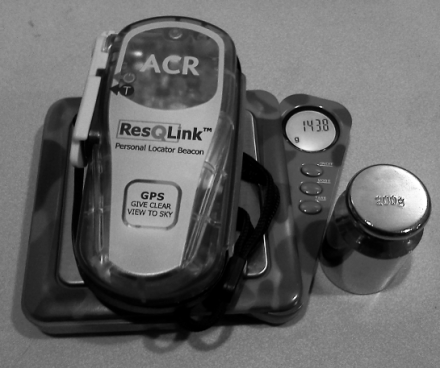
It’s measuredmass.com though, and weight matters on a device like this. It’s really just dead weight; unless you’re almost dead, then it’s useful.  The box and website claim 4.6 ounces / 130 grams. What does it say on the scale?

resqlink

143.8 grams (or 5.1 oz). That’s 11% high. Without more samples of the device, I can’t comment on product variation. The strap weighs 1.8 grams, so that isn’t the cause. For a product whose weight is an important feature, even 9% is a lot.

Continue reading

Solstice Musings

On one of the last ski lift rides of Christmas Day, the question came up, “I wonder how much longer today is than the Solstice?”

Between the two of us, we knew two things. One was that a friend had posted on the Solstice, “Happy solstice!!!! 4 extra seconds of daylight tomorrow, then 10 the next day…”  The other was that on January 29, the day is about an hour longer.

Susan’s intuitive guess was about a minute. How could we make an informed guess before the end of the chair ride?

Continue reading

Speed

How long does it take a gaggle of inbounds skiers to observe a slide, band together, figure out that beacons aren’t working for them, start probing uphill of trees, and get a successful probe strike?

7 minutes and 30 seconds.  Videos like these are going to strengthen the way we do avalanche education. Simple schemes to help unaffiliated groups to do rescue effectively will save lives.

Awesome job to everyone involved.

Rossignol X-8 Skate Boot, 48.0

RossignolX8Overview

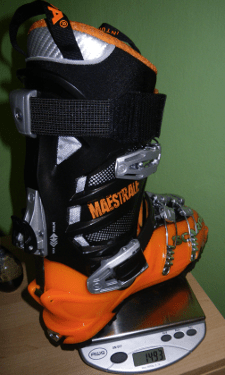
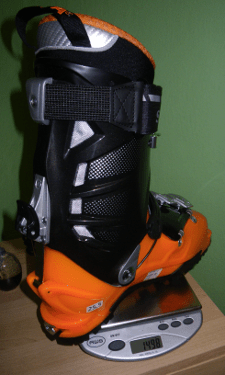
A pair of Rossignol X-8 boots came through today, just in time for the beginning of our cross-country ski season. A fit comparison with the Fischer RC3 (matching pricepoints at REI) found that the X-8 fit was somewhat wider and softer in the forefoot at equal size. The boot is soft-enough that it’s instantly comfortable.

Haven’t had a chance to get them on snow (edit: they ski great!), but it was easy to get them on the scale.

Continue reading

Black Diamond Neve Crampon

bdNeveCrampon

Aluminum crampons are great. I’d shied away from them after a friend advised, “When I really need crampons, I really want steel.” A couple of years later, my awesome girlfriend (who was tired of waiting for slowpants) got a pair for my birthday. They get the job done.

As important as climbing ability is their light weight. The Neves are 52% of the weight of my venerable cro-moly Sabreteeth; more than a pound lighter. The weight advantage makes them easy to bring along when the need for ‘pons is uncertain. I’ve used them on half the trips on which I’ve carried them; such was the summer in the Cascades.

The aluminum points stand up much better than expected to alpine rock. They wear and flex, but not quickly nor easily. While their forte is softer snow, when sharp they worked well on glazed autumn melt-freeze. They fit Mondo 30 ZZeros, Dynafit ONEs, and La Sportiva Trango S well, with room (!) for adjustment. The weights quoted here are, due to a little wear, slight underestimates of the weight when new. I’d guess I’ve worn 0.1-0.2 g of aluminum off each foot. There may be some dust in the straps, but not very much.

The weights/masses: 294.2 g for one, and 294.5 g for the other. Roughly 588.7±0.5 grams/pair.  The Black Diamond web page claims 576 grams/pair in December 2012. The pair weighed here was purchased in Autumn 2011; I can’t find a product page from 2011 for comparison. If the crampon/hardware is unchanged, then the product weight is 2% higher than advertised.

Binding Freedom Inserts

insertCloseUp

I headed up to ski today, but arrived at the gas station halfway there without a wallet. I had enough gas to get home, but not enough to ski, so it was off to the lab/shop for some ski work.

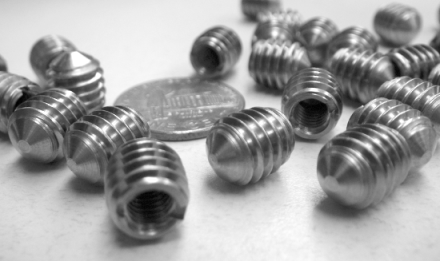
I’d played with a set of Binding Freedom inserts last season, remounting my very first pair of skis with inserts as rock skis. I’ve now drilled my Kailas and Sahales (whence the bindings came) for the inserts, and glue is curing in the Kailas. As I was cleaning up, I realized that my remaining stash of inserts would provide a nice example of how to  determine the uncertainty in product weight.

Continue reading