Fun with Torque

\vec{\tau}=\vec{r}\times\vec{F}  ?

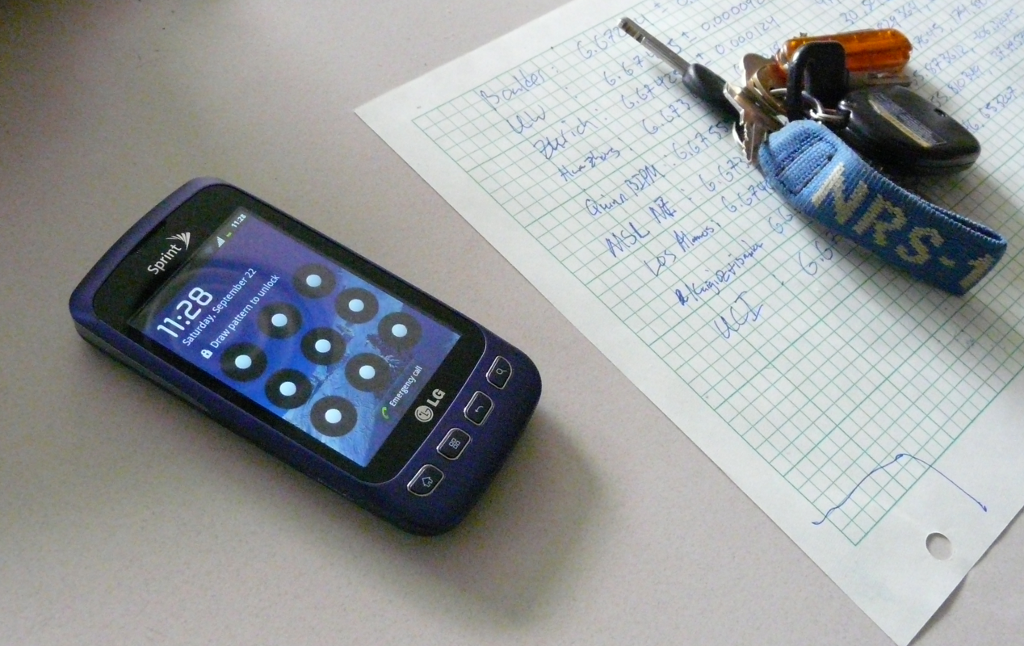
Nope, this kind of Torque – an excellent Android app that interfaces with the OBD II port in your car.

I’d bought an inexpensive “LM327” bluetooth adapter for my car months ago, but never got it running with my laptop. The Android solution worked trivially, and the application works well.

If you want to play with datalogging with Torque and you’re using the free version, you must explicitly select each sensor every time you use the application. Tedious, but free.

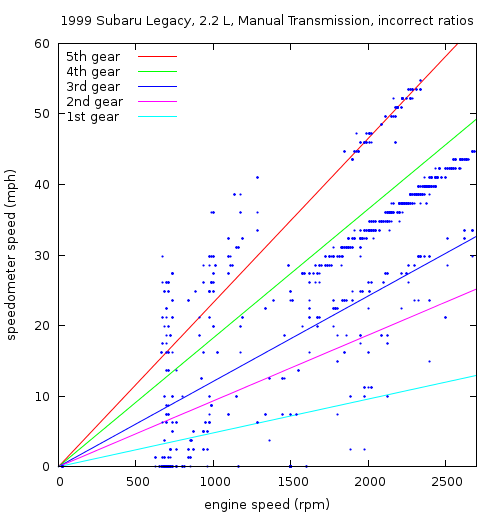
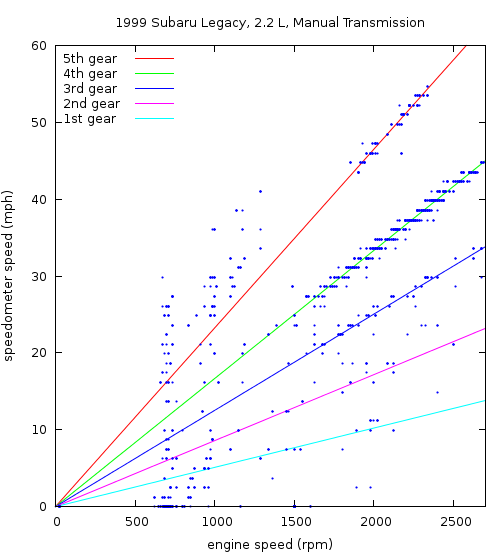
I finally went on a real drive with the car (~10-15 mi) and got logging working. There are many sensors to log, but most of them don’t betray fundamental properties of the car quite like these two do.

Lines are not fit. I tweaked the 5th gear line to match the 5th gear data, then used the gear ratios from here to predict the lower four lines. The ratios used were 3.545/2.111/1.448/1.088/0.780. Wikipedia has two values for the 5MT. The other ratio stated for “All 1990-2003 with EJ engine” of 3.785/1.945/1.500/0.994/0.780 is in obvious error when plotted with the same procedure. I submitted an edit to this effect; time will tell if it sticks.

Same plot, with incorrect ratios.

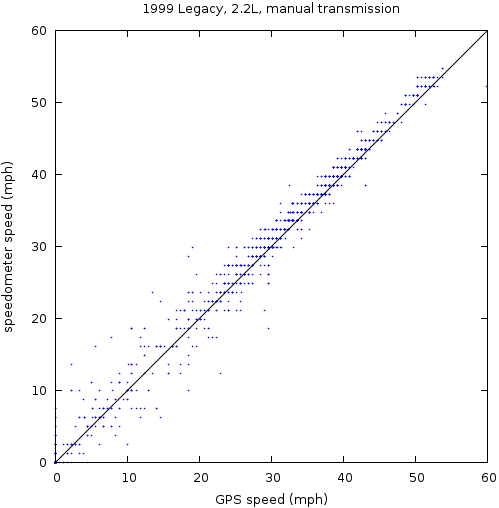
The GPS and my engine computer’s speedometer are neatly locked, but there’s about a 1 mph constant offset between them (easier to see in the residuals). Neat.

What’s the state of the academic Physics job market?

“Look! There are jobs in Physics Today again!” said officemate Matt as he leafed through the new September issue.

I had a quick look, and sure enough, there were way more than last month. Great.

But, there’s a very strong annual cycle to hiring in Physics. I’d only ever observed it qualitatively. Since I will need a physics job relatively soon, I decided to make my understanding more quantitative.

Thanks to our lab’s collective archive of Physics Todays (thank you Anne, Claire, Dan, Michael, Matt, Nikolai, and Scott!), I compiled the plots below.

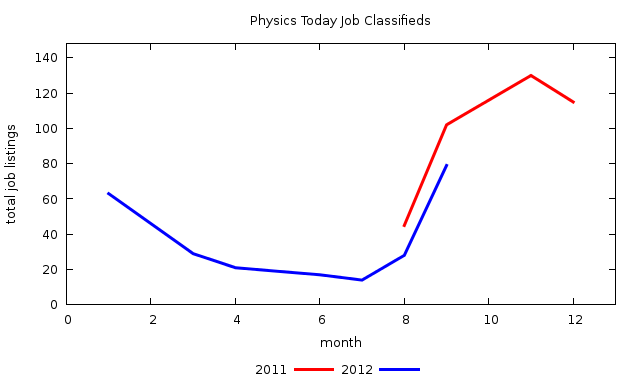
First, I made a detailed survey of the past year’s hiring.
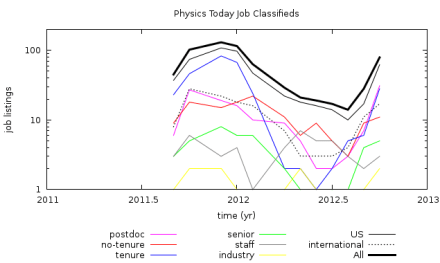
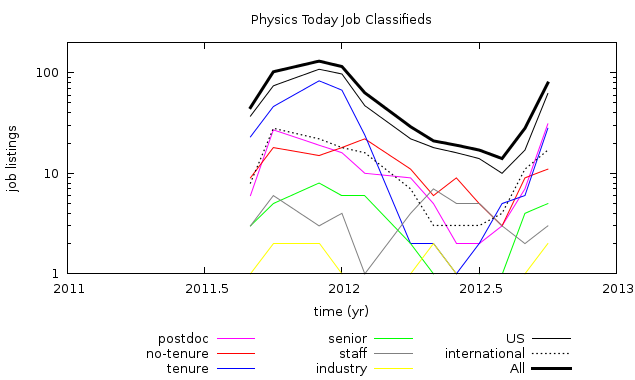
There are many ideas one may learn from this plot, but perhaps the strongest signals are that hiring is very seasonal, and that the majority (it’s a logarithmic plot!) of the advertised positions were for faculty in the main hiring sequence (advertise Autumn, apply Winter, interview Spring, start late Summer).

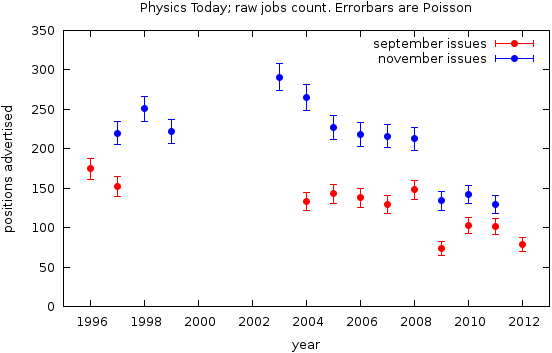
Are there more jobs this year than last year?
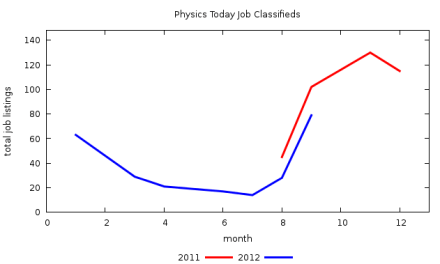
Guess not.

Compiling detailed breakdowns by job type is tedious, slow, and subjective. Most interesting to me was the total count.

How does the number of advertised jobs now compare with the past?
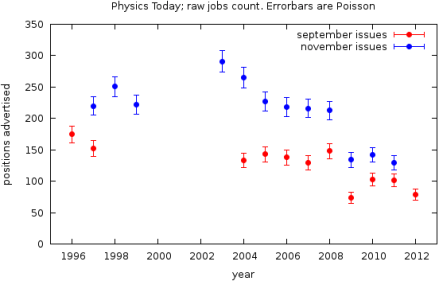
Systematic uncertainty?

Chatting with Dr. Tolich about the plot brought to light an important systematic concern: Free online advertising is becoming prevalent (SPIRES has a job mill, and there are others (edit to add one: academicjobsonline.org )). The minimum charge for a Physics Today ad is $525. There are rumors that at least one major department discussed not placing a print ad for recent positions on cost concerns. If job seekers find jobs on the web, why pay for print? I’d never heard of the SPIRES listings, so at least some luddites still prefer print.

Today (September 20, 2012), there are “272” jobs on physicsjobs.com, the online branch of Physics Today (but they charge $525 for online listings; a minimum-length print ad is free). SPIRES claims to have 1420 jobs. Academicjobsonline.org has 76 in narrowly-tailored “Physics”. Make of the situation whatever you will.

With more time/interest, I have the archives needed to add other useful months (October, December, January), but the initial curiosity is sated; there are fewer print-advertised jobs than there used to be.

Appendix: Counting

What counts as a job, in the counts above? An advertisement for “several” positions, without quantitative reference to assured positions, counts as one. “Two or more” positions count as two. Blunderbuss advertisements from National Labs count as one (they typically have many positions open, and I’m not convinced that the ~four highlighted jobs reflect the number of open positions).  Only post-graduate positions count.

Counting is slow, and I have a thesis to write, so I haven’t recounted each point. Recounts (was that 87, or 88? Arg.) of a few Novembers suggest a ~±2% variation in counting/subjective judgement.

A word to hiring committees: “Two” or “three” sounds much more concrete to an applicant than “several”. “Several” sounds like the department doesn’t yet have university approval for multiple hires.

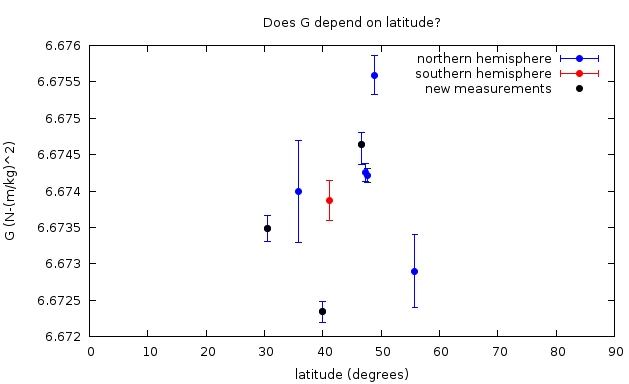
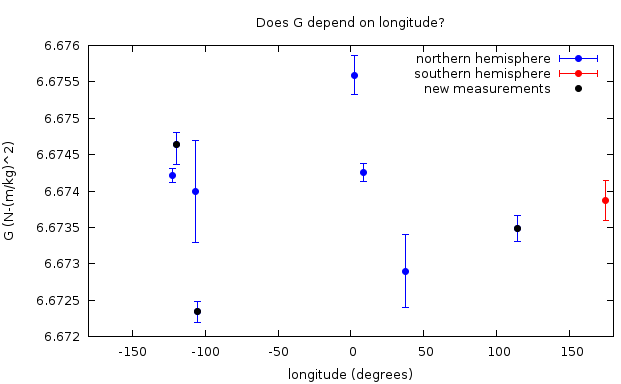
Does the Gravitational Constant depend on Latitude?

Newton’s Gravitational Constant has been the subject of controversy for decades. The measurements are very hard. The CODATA value’s uncertainty has been revised upwards and downwards, and may soon go up again. Three recent measurements ( <– three links here) have added tension. All three disagree with one another, and two disagree strongly with the accepted value.

There have been suggestions by theorists that the value of G might vary spatially on Earth’s surface. It’s difficult to reconcile such a notion with other precision tests of gravity, but there’s no substitute for experiment.

The data used for these plots are from the experiments noted here. The latitude and longitude are approximate and use the google maps datum.

Can the new precision experiments’ disagreement be explained by spatial variation? For model-independence I don’t attempt any fits. Plots will have to do.

Image

Image

Should I switch to Ting?

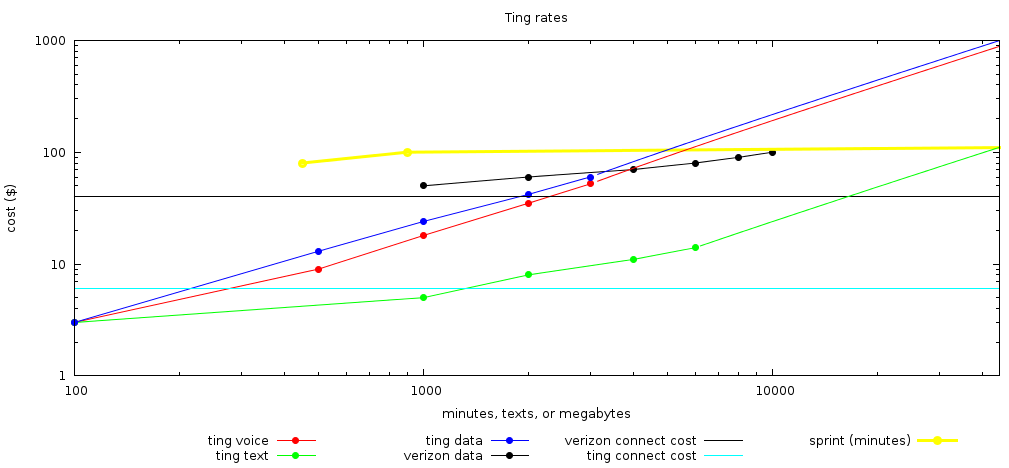
Ting.com is a new virtual wireless company. They resell time on Sprint’s network, and use a pay-as-you-go model of billing. You buy your own mobile device, pay a monthly access fee, and then pay only for whatever service you consume. It’s the way of the future.

Future or not, it could still be overpriced. Hence this plot. Sprint theoretically roams on Verizon, and only Verizon offers the mountain coverage I require, so AT&T’s not plotted.

Image

Complicated, right? Since there are three variables (minutes, texts, data), and one price, the natural realm for this problem is in four dimensions. Note, for giggles, that 44640 minutes (or less) is a month.

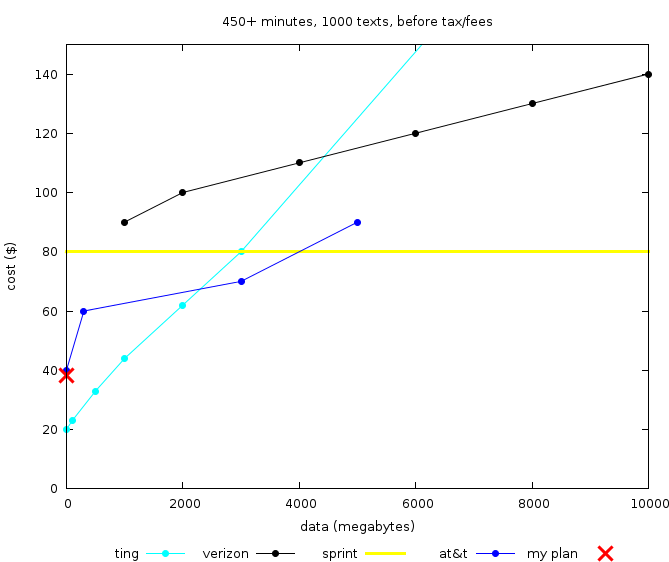
I retreated back to the problem I’m personally interested in: Should I switch? Note that this plot does not include the significant (or subsidized) cost of a phone. I use about 500 minutes of voice a month and send more than a hundred texts.  How much data can I use before Ting is no longer the optimal choice?

My current Verizon plan is ~$40/month before fees with no data. Ting beats that handily. The steep light-blue line must be a way that Ting (or their Sprint overlord) plans to make money. Ting is a great deal for small usage, but very poor for lots of usage.

Atomic Kailas 185cm (drilled/used)

These are the green ones.

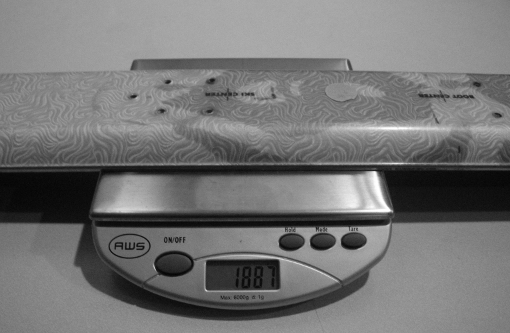
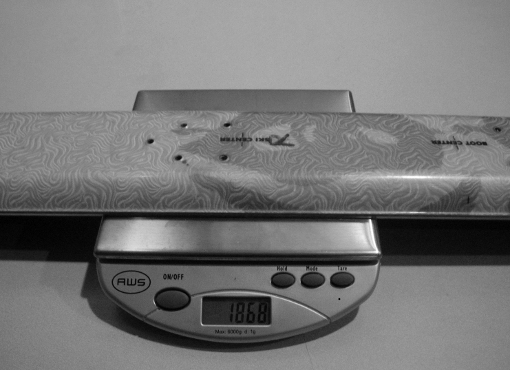
A friend gave a wonderful deal on nearly pristine and well loved skis. They’re about to get mounted, so it’s time to weigh ’em. These skis have been drilled once for dynafits, and for Voile ski crampons. I think the previous owner stone ground them at least once. I expect them to be lighter than new.

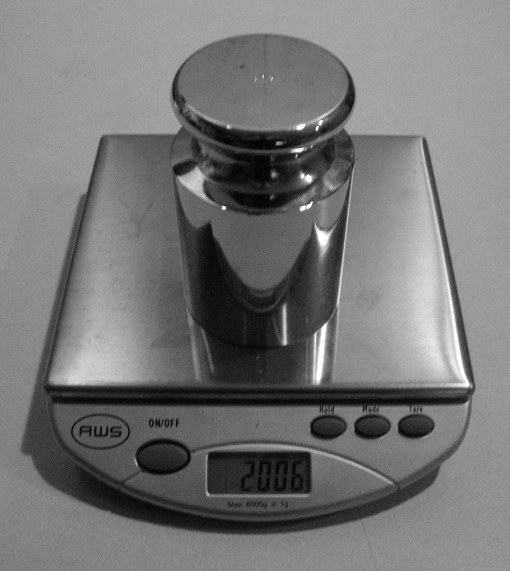
My scale is designed for calibration with a 4 kg standard, but I only have a 2kg standard. So, I do the correction by hand. Actual mass = ( measured mass  x 2000/2006).

Image

Corrects to 2000g.

Image

Corrects to: 1881 g

Image

Corrects to 1862g.

Average mass 1872g.

Couldn’t find the manufacturer’s spec for the 06/07 year, but 07/08 had a claimed weight of 3750g/pair, or 1875 g/ski.

Edit: 3/14/2013

I’ve finally gotten a few days on these skis, after mounting them with inserts. They’re a rather neutral ski. They like to be driven, but will tolerate small quantities of backseat driving. I’m accustomed to slightly shorter (~177 cm) skis, so tricky conditions require a little more forethought. The previous owner kept the bases and edges in pristine condition, so edgehold is excellent. As with Kongurs in the same length, I haven’t yet found a speed limit, even on ripper groomers. Nice skis.

Michelin Kromion

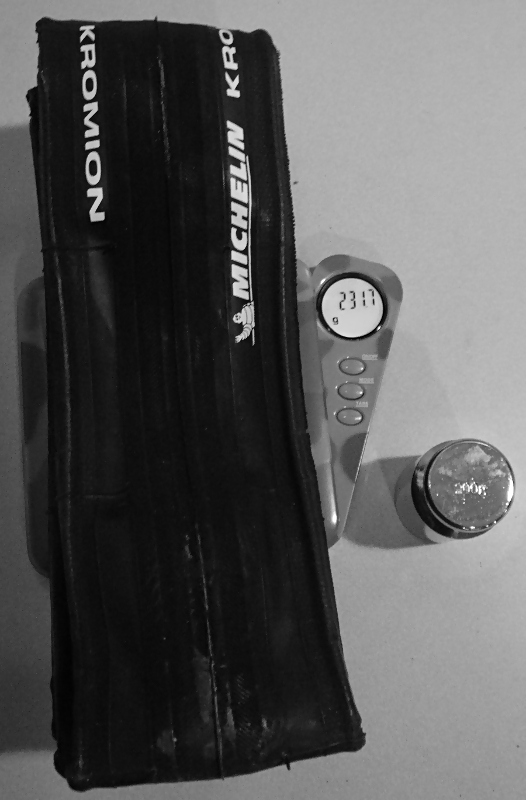
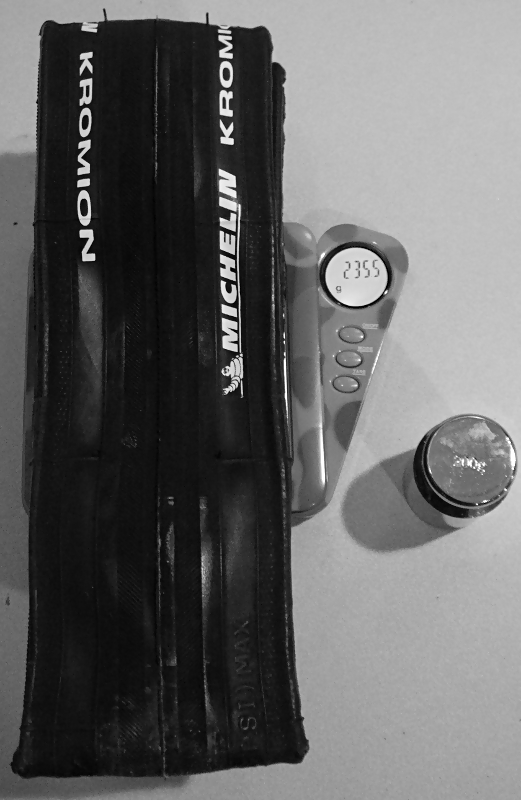
New tires came with the saddle. Manufacturer spec is 230g.

231.7 g and 235.5 g. At worst, 2.4% off spec. Drawing the same inference as in the previous entry (with no extra conservatism), this yields (with some uncertainty about the 3.4): 233.6 +/- 3.4 g, easily consistent with a 230g spec.

I saved less weight than I’d expected simply because my worn tires were lighter than specified by the manufacturer. I’m looking forward to lightening these Kromions further by riding!

Folding tires are a really inexpensive way to pull a little mass (and moment of inertia) out of your bike. Wire beads are heavy.

Nashbar R2 Saddle

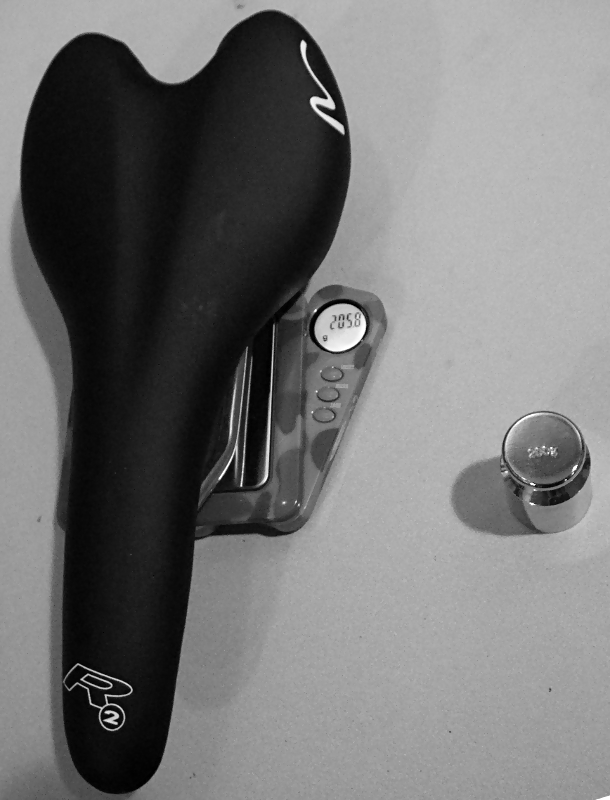
New saddle arrived. Feels nice, feels light, looks cool, magnet doesn’t stick to seat rails.

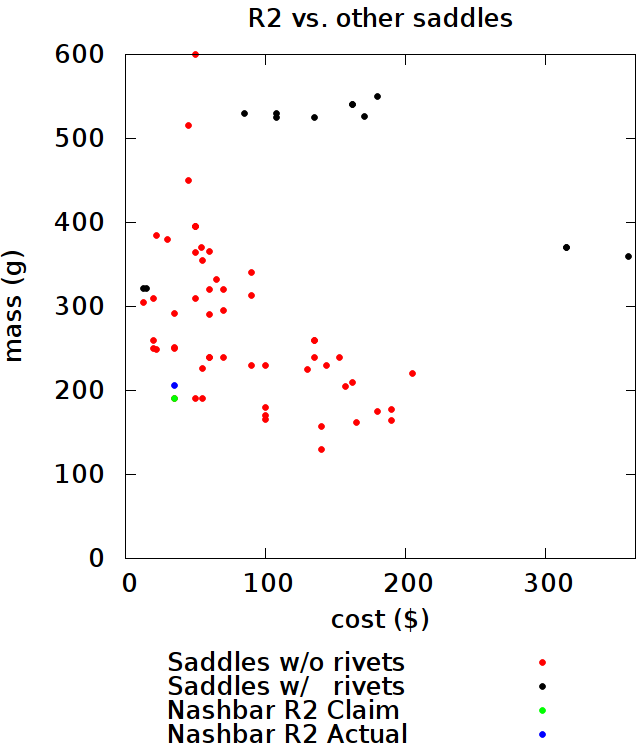
Nashbar claims 191 grams. I get 205.8. That’s 7.8% high. Weighing, as before, used the AWS Blade scale calibrated using the 200 g weight.

I wanted to put this in perspective, so I looked up the prices of the other saddles that Nashbar sells.

My first takeaway is that old-style riveted leather saddles are heavy. The second is that, while the R2 remains a value, I’d be very unhappy with Nashbar’s claimed 191 g weight if I manufactured the 190g saddles priced at $50-55.

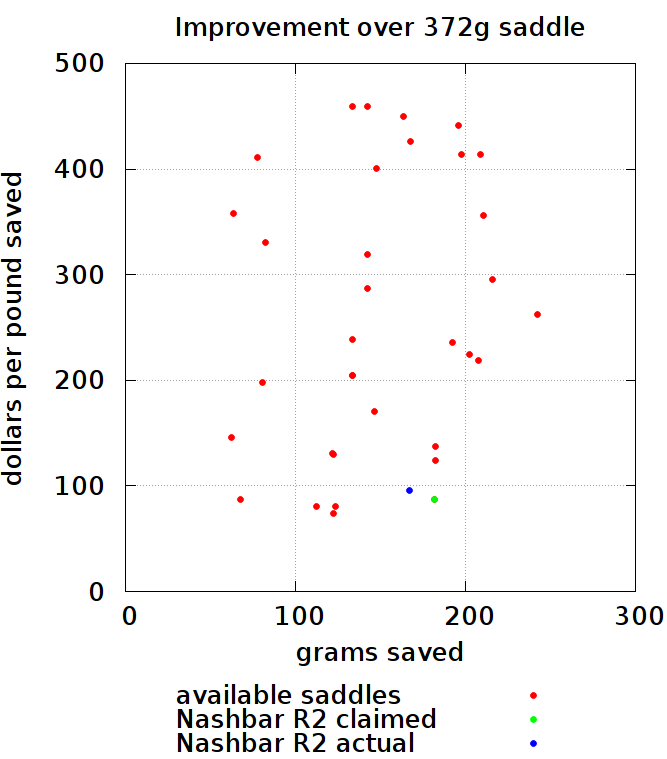
I see 8% less weight savings than expected using the R2, but how much less attractive does that make the saddle?

As shown in green, the claimed weight netted me weight savings at $87.57 per pound. In reality, it cost me $95.35 per pound, and my bike’s mass is 15 grams more than expected.

Reviews at Nashbar.com state that the saddle weighs 214, 208, 209, and 220 g.  Averaging them together with the measured 205.8g yields 211 +/- 5.7 g. With only 5 samples and normally-distributed data, the uncertainty in the variance is considerable, and is slightly underestimated (by 7 %). Call it 211 +/- 6 g. Since Nashbar has lawyers, we don’t have very many samples, not all scale users know what they’re doing, and process variations aren’t always Gaussian, let’s double the variation, to 211 +/- 12 g (that’s almost an ounce variation, peak to peak).   Using these data, if the saddle masses are “normally distributed”, less than one in ten saddles will have mass at or below 191g. 

Weight-wise, the R2 remains a compelling value for budget-minded buyers, just not the exceptional value 191g presents. If the R2’s mass is consistently higher as than 191g, as reviews indicate, then the saddle is improperly labelled and advertised. If the manufacturing process yields saddles that are 176g as often as it does 206g saddles, quantified variation (expressed as 191 +/- 15 g) would be a straightforward consumer resource.

Crank Brothers Eggbeater 1

Over the weekend, we went on a long bike ride. It was fun, but I was slower than I wanted. So, in addition to resolving to get more exercise, I took a look at the weight of my bicycle.

Lots of disassembling, weighing parts, and playing with spreadsheets ensued. Ultimately, I decided to replace my worn tires (wire beads add 100g per tire!), rattly clipless pedals, and saddle. If manufacturers meet spec, I’ll have dropped about a pound from my 24 pound bike for ~$100. This isn’t the optimal weight/dollar way to get to a 18 lb bike, but it’s a way to spiff up a favorite bike.

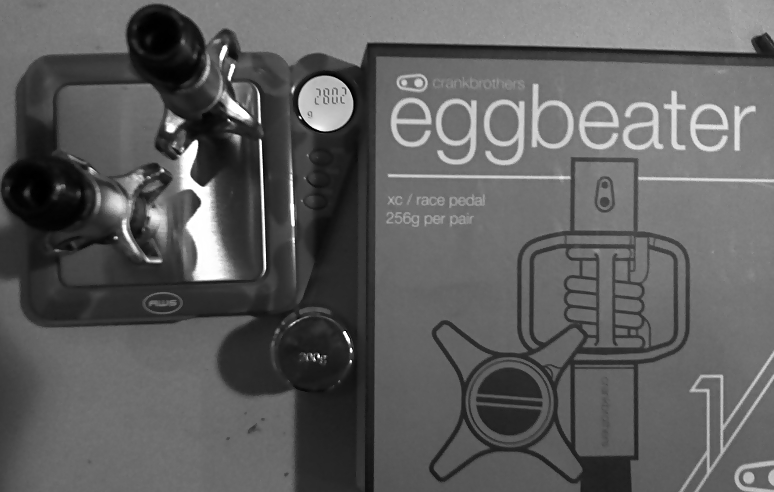
The first package arrived in the mail yesterday – Crank Brothers pedals from REI. Listed as 256 grams per pair,  these should save 110g over the old pedals. Opening up the package, they look and feel great.

Image

Here’s what arrived. 280.2 grams.

Nearly 10% high. For a weight quoted to three significant figures in an industry obsessed with weight, that’s a letdown. In real terms, it’s the weight of an extra granola bar per pair. Or, if you’re a triathlete, three quarters of a pack of GU. As a customer, I saved 22% less weight than I expected with this purchase.

It’s not a gross manufacturing inconsistency; the two pedals mass 140.0 and 140.3 g (+/- 0.1 g statistical uncertainty).

Balance is an American Weigh Blade 400, calibrated with an American Weigh 200g calibration mass. At present, I trust the calibration mass to about a gram. The manufacturer specifies at least 0.1 g. I haven’t yet checked it on a superior balance.